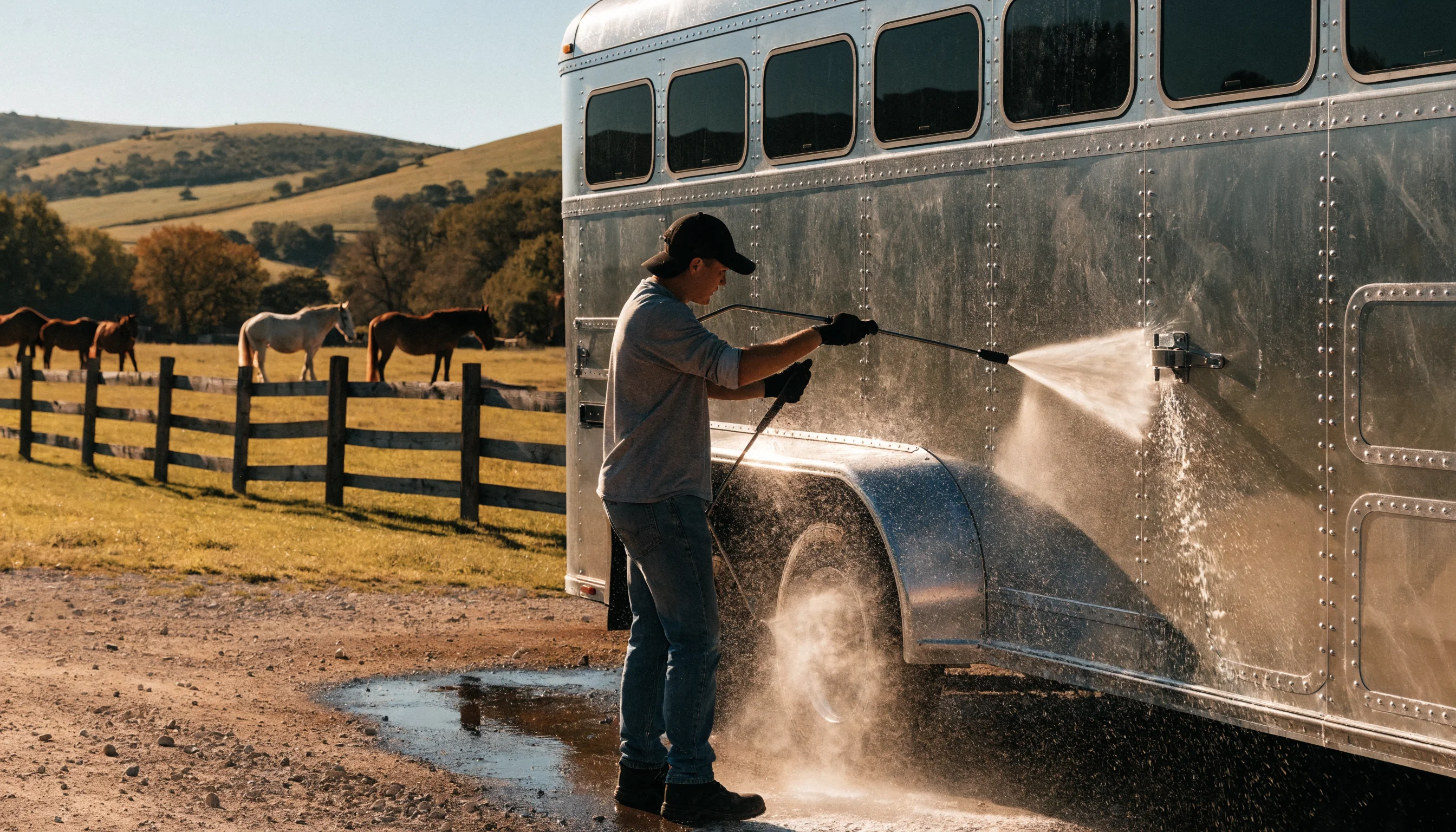
Why Livestock Trailers Need Special Attention
A livestock trailer isn't a camper, and cleaning one isn't like cleaning a travel trailer. The environment inside a horse trailer is harsh: moisture from animal sweat and breath, ammonia from urine, organic matter from manure, and abrasion from hooves hitting walls and floors. Over time, this combination causes corrosion, deep-set odors, bacterial buildup, and finish deterioration that a garden hose can't touch.
We work with horse owners and ranchers throughout Elizabeth and Franktown — communities with a strong equestrian tradition. We understand these trailers are working equipment, not showpieces. But keeping them clean isn't just cosmetic — it's about animal health, trailer longevity, and resale value.
Here's what happens when livestock trailer cleaning gets deferred:
- Ammonia damage — urine residue produces ammonia, which corrodes metal, degrades rubber mats, and creates a respiratory hazard for both horses and handlers
- Bacterial buildup — organic matter in crevices, drainage channels, and floor joints harbors bacteria that can lead to hoof infections like thrush
- Rust and corrosion — moisture trapped under mats and in wall joints eats through steel faster than you'd expect in Colorado's dry-wet temperature cycling
- Permanent odor — ammonia and organic compounds seep into porous surfaces and become nearly impossible to remove without professional extraction and treatment
Sanitization and Odor Elimination
A proper livestock trailer detail goes beyond scrubbing the floor. Here's our process:
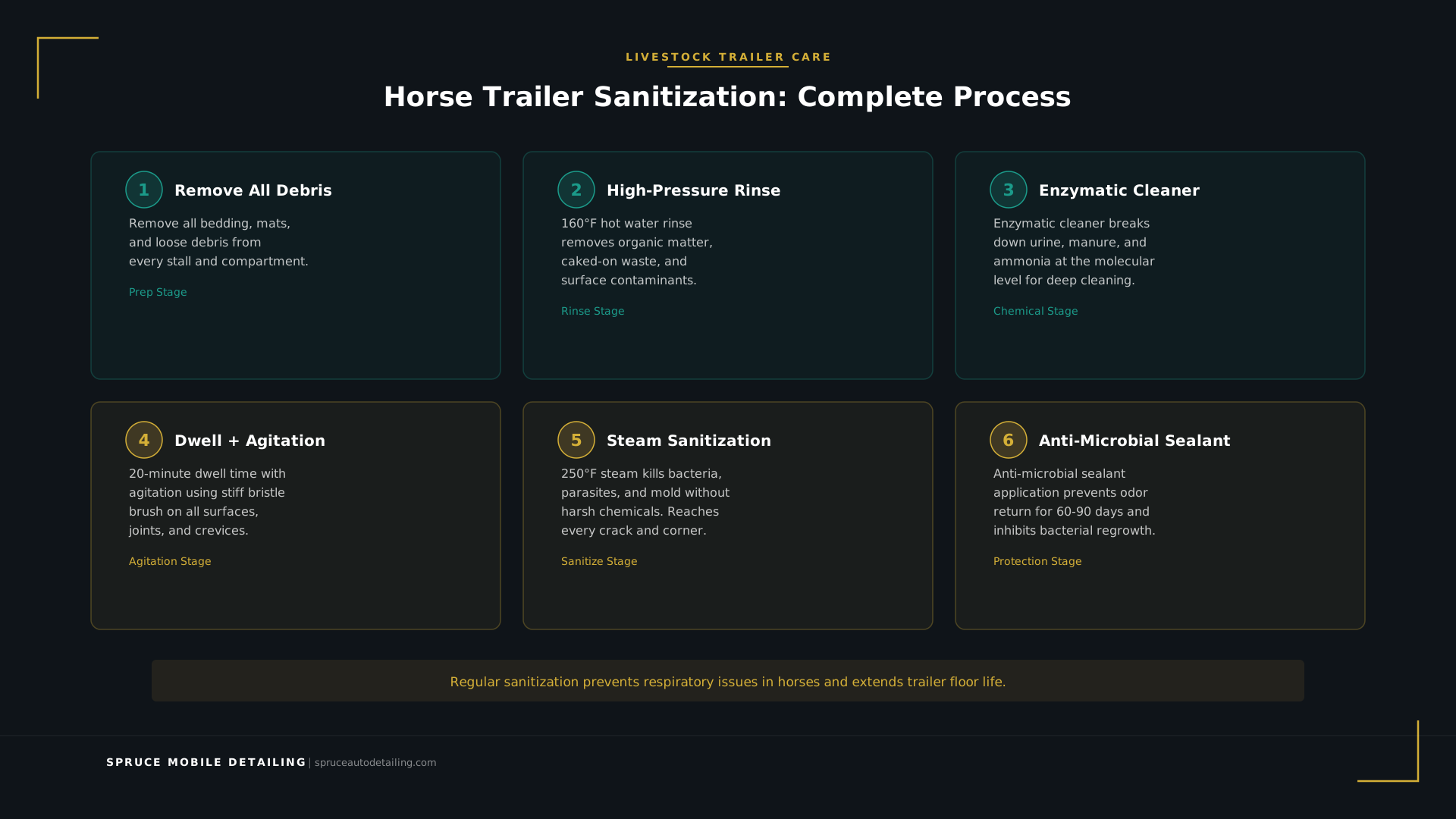
Step 1: Strip and rinse. We remove all rubber mats, dividers (if removable), and accessories. Everything gets cleaned separately. The bare floor, walls, and ceiling get a thorough rinse to remove loose manure, hay, and bedding material.
Step 2: Degrease and disinfect. We apply a commercial-grade, livestock-safe disinfectant to all interior surfaces. This kills bacteria, breaks down organic compounds, and reaches into the joints, drainage channels, and crevices where contamination hides. We let the disinfectant dwell for the manufacturer's recommended contact time — rushing this step defeats the purpose.
Step 3: Scrub and extract. Using stiff brushes and hot water extraction, we scrub walls, floors, and ceiling areas. The extraction pulls dissolved contaminants and moisture out of porous surfaces rather than just spreading them around.
Step 4: Odor treatment. For trailers with embedded ammonia or manure odor, we apply an enzymatic odor eliminator. Enzymes break down the organic compounds causing the smell at a molecular level — they don't just mask the odor, they eliminate the source. This is the same approach we use for RV interior detailing when dealing with pet odors and smoke damage.
Step 5: Dry and inspect. We force-dry the interior to prevent immediate moisture issues. During the drying process, we inspect for any corrosion, floor damage, or wall deterioration that was hidden under dirt and grime.
Aluminum Trailer Care (Matte vs Polished)
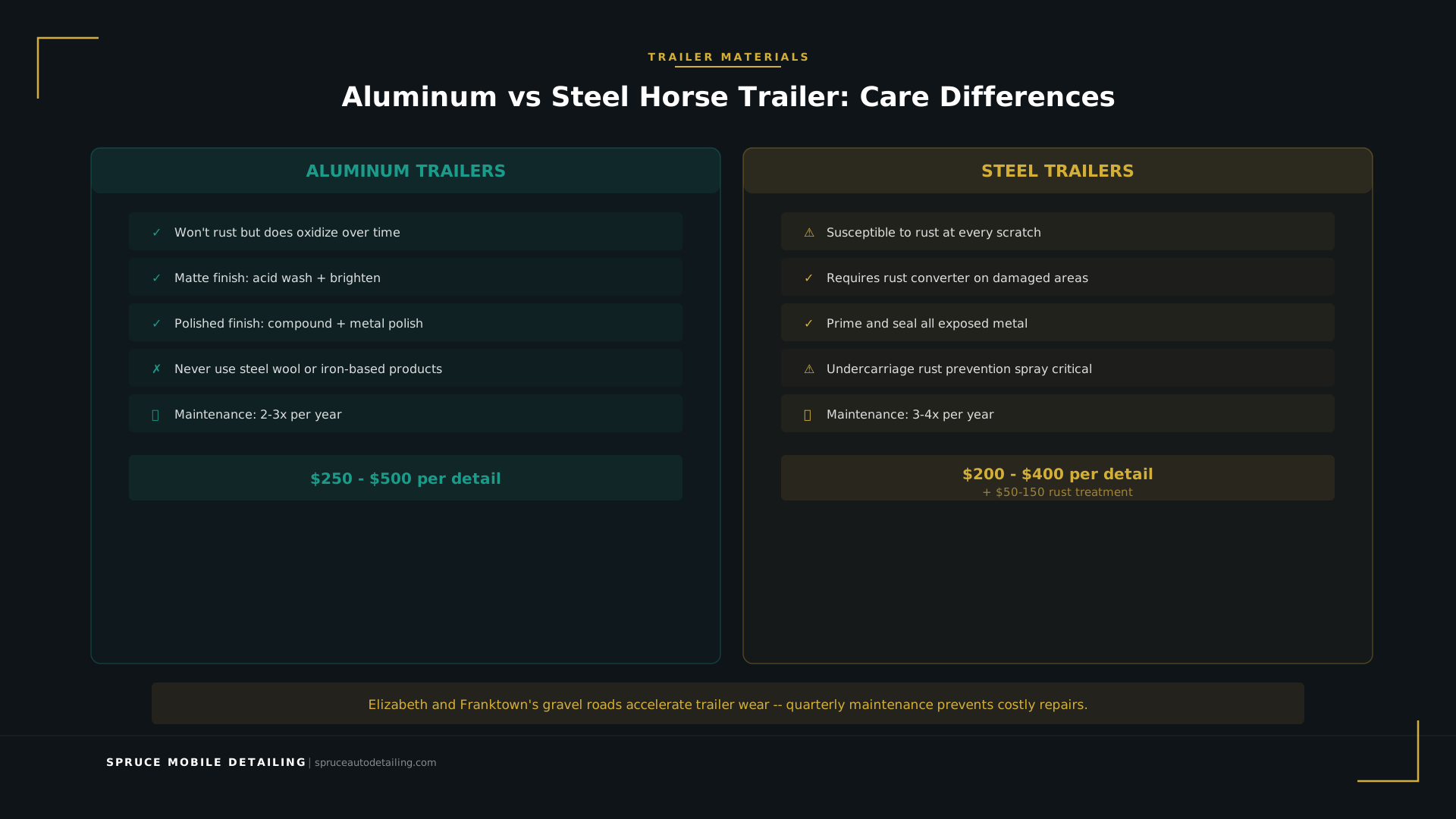
Most horse trailers in the Elizabeth and Franktown area are aluminum — either matte (mill finish) or polished. Each requires a different approach, and using the wrong technique on the wrong finish creates problems.
Matte (mill finish) aluminum:
- This is the raw, unpolished aluminum common on stock trailers and many utility horse trailers
- Clean with a mild aluminum-safe cleaner — avoid acid-based aluminum brighteners, which can etch and pit the surface
- Focus on removing water spots, road grime, and oxidation with a non-abrasive approach
- Do NOT try to polish a matte trailer to a mirror finish — the surface isn't designed for it, and you'll create an inconsistent appearance that's impossible to maintain
- Protect with a spray sealant designed for bare metal
Polished aluminum:
- The mirror-finish aluminum you see on high-end horse trailers like Exiss, Cimarron, and Logan Coach
- Polish with a dedicated aluminum polish using a rotary buffer or by hand with a microfiber applicator
- Work in small sections to prevent the polish from drying before you buff it off
- Seal immediately after polishing — bare polished aluminum oxidizes within days in Colorado's dry, UV-heavy environment
- Regular polishing (every 3-6 months) keeps the finish reflective and prevents the dull, chalky look of oxidized aluminum
Aluminum-specific knowledge matters here. Standard car wax isn't formulated for bare aluminum and can actually accelerate oxidation. We use products designed specifically for aluminum trailer care.
Free Quote
Time to give your trailer the cleaning it deserves?
We come to your home or office in Castle Rock and throughout Douglas County.
Rust Prevention for Steel Trailers
While aluminum dominates the horse trailer market, steel trailers are still common — especially older models, stock trailers, and flatbed/utility trailers used for livestock. Steel's biggest enemy is rust, and the livestock trailer environment accelerates it.
Here's our approach to protecting steel trailers:
- Thorough cleaning first — rust prevention products don't bond to dirty surfaces. We clean all steel surfaces down to bare metal where needed
- Rust treatment on existing spots — we use a rust converter on any active rust. This chemically transforms iron oxide into a stable compound that can be painted or sealed over
- Undercarriage attention — the frame, axles, and underside take the worst abuse from road salt, mud, and moisture. We clean and treat the undercarriage as part of a full trailer detail
- Protective coating — after cleaning and treating, we apply a rust-inhibiting coating to vulnerable areas. This is especially important for trailers stored outdoors in Colorado where freeze-thaw cycles drive moisture into every joint and seam
The floor is the most critical area. Horse trailer floors (steel or aluminum) take constant abuse from hooves, moisture, and the weight of the animals. Inspect your floor mats regularly — rust developing under the mats is invisible until the floor is compromised. We lift all mats during our detail process and flag any floor deterioration we find.
Scheduling for Horse Owners
We understand that horse people are busy. Between feeding schedules, training, shows, and the general reality of managing horses and property, finding time for trailer maintenance isn't always easy. Here's how we make it work:
- We come to your property — no need to haul an empty trailer somewhere. We detail at your barn, your ranch, or wherever the trailer is parked in Elizabeth, Franktown, and the surrounding areas
- We work around show season — need the trailer detailed before a show? We'll schedule accordingly. Many of our horse trailer clients book a detail the week before major shows at the Douglas County Fairgrounds or Parker venues
- Post-event cleanings — after a long hauling weekend, a quick sanitization prevents organic matter from setting in
- Seasonal packages — we offer recurring schedules for regular sanitization. Many of our equestrian clients do a monthly quick clean and a full detail quarterly
If you've got a truck that needs detailing too, we'll bundle the truck and trailer together. Most horse owners we work with pair a truck detail with their trailer cleaning — it makes sense logistically since we're already on-site.
Ready to get your trailer cleaned up? Contact us and tell us about your trailer — type, size, and what you're dealing with. We'll give you an honest quote and find a time that works with your schedule.
FREQUENTLY ASKED QUESTIONS
How often should I detail my horse trailer?
At minimum, a full sanitization and detail twice a year — spring and fall. If you haul frequently (weekly or biweekly), a monthly quick sanitization plus a full detail every quarter is ideal. The key is not letting organic matter sit for extended periods, which causes the worst corrosion and odor issues.
Can you detail my horse trailer at my barn?
Yes. We're a mobile service and we come to your property. We detail horse trailers at barns, ranches, and private properties throughout Elizabeth, Franktown, and Douglas County. We bring our own water supply and equipment.
Do you use chemicals that are safe around horses?
Absolutely. All disinfectants and cleaners we use in livestock trailers are livestock-safe and biodegradable. We rinse thoroughly after cleaning and allow proper dry time before the trailer is used again. We'll let you know the recommended wait time before loading animals.
Can you polish my aluminum horse trailer?
Yes. We polish both matte and mirror-finish aluminum using products and techniques designed specifically for aluminum trailers. We'll assess whether your trailer has a mill finish (matte) or polished finish and use the appropriate approach. We also seal the aluminum after polishing to protect against oxidation.