What Ceramic Coating Actually Does
Before we talk about whether it's worth it, let's clarify what ceramic coating actually does on an RV — because there's a lot of misinformation out there.
A professional-grade ceramic coating is a liquid polymer that chemically bonds to your RV's gel coat or paint. Once cured, it creates a semi-permanent layer that's harder than the surface underneath. It's not a wax. It's not a sealant. It's a fundamentally different type of protection.
Here's what a ceramic coating does:
- UV protection — the coating absorbs ultraviolet radiation before it reaches your gel coat, dramatically slowing oxidation and fading
- Hydrophobic surface — water beads up and rolls off, taking dirt and contaminants with it
- Chemical resistance — bird droppings, tree sap, bug acids, and road salt sit on the coating instead of etching your finish
- Easier cleaning — a coated RV washes faster because contaminants don't bond to the surface as aggressively
- Gloss enhancement — the coating adds measurable depth and clarity to your finish
Here's what it does NOT do:
- It won't make your RV scratch-proof
- It won't eliminate the need for washing
- It won't fix existing oxidation (that has to be corrected first)
- It won't replace proper maintenance — it makes maintenance easier, not optional
RV-Specific Benefits (Large Surface, Outdoor Storage)
Ceramic coating on an RV works differently than on a car in a few important ways, and most of them work in the RV owner's favor.
Surface area amplifies the benefit. Your RV has 3-5x the surface area of a car. That means 3-5x more surface exposed to UV, rain, and contaminants every day. Protecting all that surface with wax means reapplying every 4-8 weeks across hundreds of square feet. Ceramic coating provides that protection for years with no reapplication.
Outdoor storage is the norm. Most RV owners in Castle Rock and Douglas County store their rigs outside, either at home or at a storage lot. That means your RV is absorbing UV damage 365 days a year, not just when you're driving it. Ceramic coating protects during storage — wax breaks down whether you're using the rig or not.
Washing becomes dramatically easier. A coated 35-foot fifth wheel might take 45 minutes to wash instead of two hours because dirt and grime release from the surface with less effort. Over the course of a camping season, that time savings adds up significantly.
Black streak prevention. Those dark streaks running down the sides of your RV from the roof? They're caused by water carrying pollutants, mold, and rubber residue down the sidewalls. On a coated surface, that water runs off instead of leaving tracks. Coated RVs develop far fewer black streaks.
When Ceramic Makes Sense
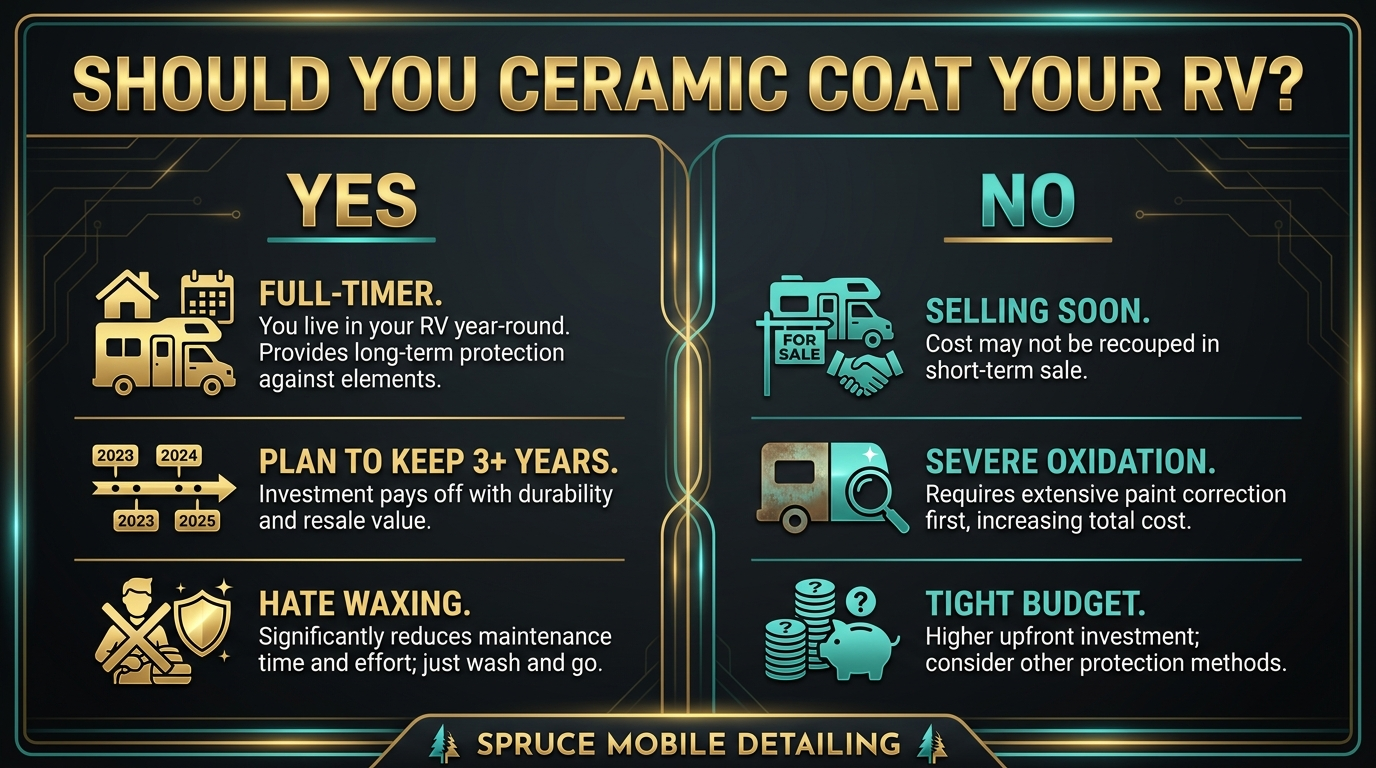
Ceramic coating is a smart investment for RV owners who check most of these boxes:
- You store your RV outside — this is the single biggest factor. If your rig sits uncovered in Colorado sun year-round, ceramic coating provides continuous UV protection that wax simply can't maintain
- You plan to keep the RV for 3+ years — the upfront cost needs time to pay itself back through reduced maintenance and preservation of your finish
- Your RV is in good condition — coating works best when applied to gel coat that's clean, corrected, and free of oxidation. It locks in whatever condition the surface is in
- You value your time — if spending a full day waxing your rig every couple months doesn't appeal to you, the easier-maintenance benefit of ceramic is real
- Your RV is a significant investment — Class A and Class C motorhomes, luxury fifth wheels, and high-end travel trailers represent $50K-$300K+ investments. Protecting that finish makes financial sense
We work with a lot of RV owners in the Douglas County area who camp regularly from May through October, then store their rigs over winter. Ceramic coating protects during both seasons — active use and dormant storage.
Free Quote
Want to know if ceramic makes sense for your RV?
We come to your home or office in Castle Rock and throughout Douglas County.
When It Might Not Be Worth It
We'd rather be honest with you upfront than sell you something that doesn't fit your situation. Ceramic coating might not be the best move if:
- You're selling the RV within a year — you won't recoup the cost in resale value alone, and the next owner gets the benefit
- Your RV is heavily oxidized and you're on a tight budget — the gel coat needs to be fully corrected before coating, which adds significant cost. If restoration plus coating exceeds your comfort zone, start with restoration and a quality sealant instead
- You only camp a few times per year — if your RV sits in covered storage 11 months a year and comes out three weekends, the UV exposure is limited enough that wax protection may be adequate
- Your RV has a rubber roof — ceramic coating applies to the body panels, not rubber EPDM roofs. If roof protection is your primary concern, coating the body alone may feel like an incomplete solution
- You're comparing it to a $50 spray coating — consumer-grade spray coatings from the auto parts store aren't the same product. Professional ceramic coating is a multi-step process with industrial products. If you're thinking of it as a $50 weekend project, we're talking about different things
There's zero shame in choosing wax or sealant. A $300 wash-and-wax done regularly protects your rig. It just requires more frequent reapplication.
Cost vs Long-Term Value
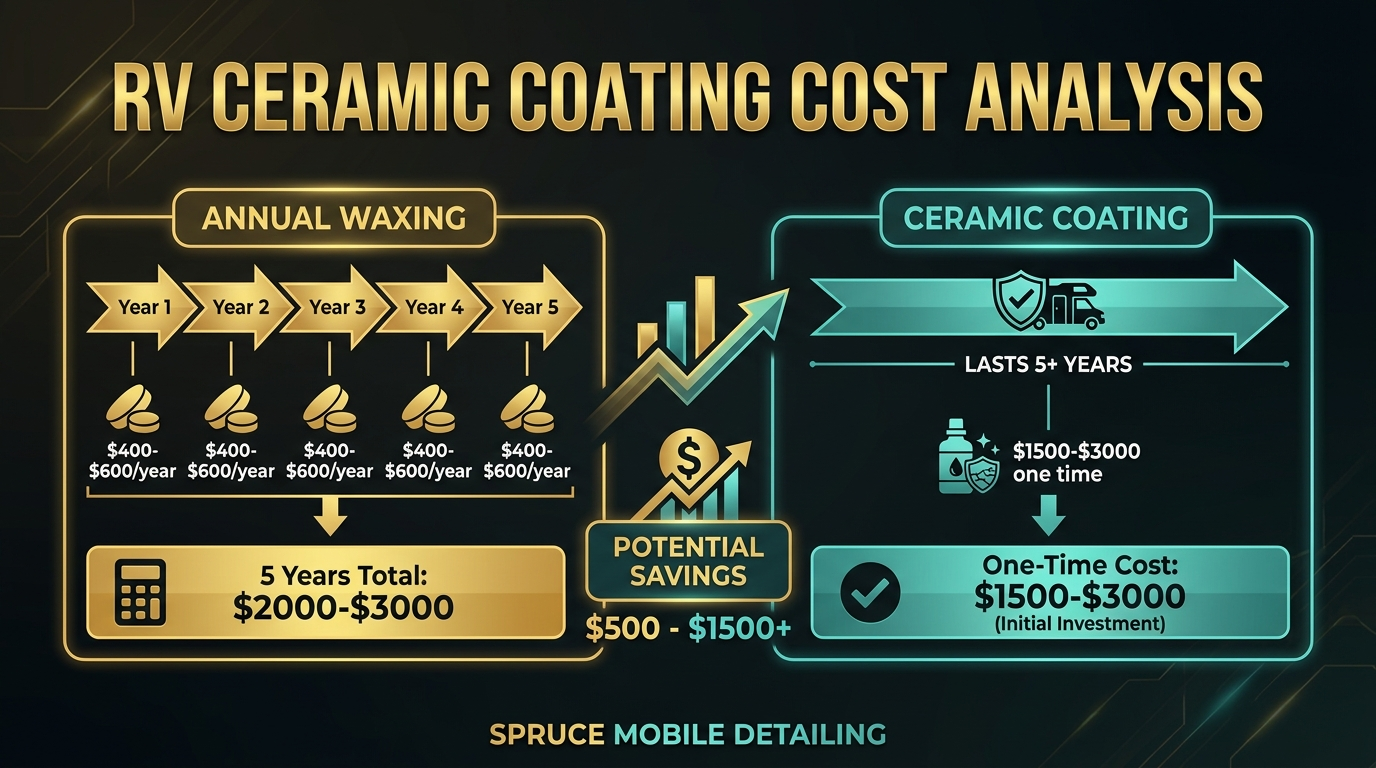
Let's put real numbers on this. Here's a rough comparison for a 30-foot Class C motorhome stored outside in Castle Rock:
Option A: Wax protection over 5 years
- Wash and wax 4x per year at $300-$400 each = $1,200-$1,600/year
- Oxidation correction every 2 years at $800-$1,200 = $400-$600/year
- Total over 5 years: approximately $8,000-$11,000
Option B: Ceramic coating
- Initial correction and ceramic coating: $2,500-$4,000 (one-time)
- Maintenance washes 4x per year at $150-$200 each = $600-$800/year
- Coating maintenance/inspection annually: $200-$400
- Total over 5 years: approximately $6,500-$10,000
The numbers are close, but ceramic coating wins in two areas wax can't match: consistent protection (your finish is protected every day, not just the weeks after a fresh wax) and time savings (each wash is faster, and you never spend a full day re-waxing).
If you store indoors, the math shifts toward wax because UV exposure drops dramatically. If you store outside and camp frequently, ceramic coating is almost always the better long-term value.
We offer free assessments for RV ceramic coating. We'll look at your rig's current condition, discuss your storage and usage patterns, and give you an honest recommendation — even if that recommendation is to stick with wax.
FREQUENTLY ASKED QUESTIONS
How long does ceramic coating last on an RV?
Professional ceramic coatings like System X and Glidecoat last 2-5 years on an RV depending on storage conditions, maintenance, and UV exposure. In Colorado's high-UV environment with outdoor storage, plan on the lower end of that range unless you maintain the coating with annual inspections and touch-ups.
Can you ceramic coat a fiberglass RV?
Yes. In fact, fiberglass and gel coat surfaces respond excellently to ceramic coating. The coating bonds to the gel coat and provides the same UV protection, hydrophobic properties, and chemical resistance as it does on automotive paint. We use coatings specifically formulated for gel coat and fiberglass.
Does ceramic coating prevent black streaks on RVs?
It significantly reduces them. Black streaks form when water carries pollutants and roof residue down the sidewalls and bonds to the surface. On a ceramic-coated RV, the hydrophobic surface causes water to bead and run off instead of sitting and staining. Most coated RVs still benefit from regular washing, but the streaks are far less severe and much easier to remove.
Do I need to fix oxidation before ceramic coating?
Yes. Ceramic coating is not a repair product — it's a protection product. It bonds to whatever surface condition exists and locks it in. If you coat over oxidation, you're locking in a dull, chalky finish. The gel coat needs to be fully corrected (compounded and polished) before coating for the best results.