
The Ceramic Coating Question Everyone Asks
Updated October 2026: We added sections on Castle Rock weather, ceramic coating versus spray coatings, how long application takes, and what a coating can and cannot do.
“Is ceramic coating worth it?” is one of the most common questions we hear from customers in Castle Rock and Douglas County. The short answer for most car owners is yes. However, the overall answer depends on your vehicle, your expectations, and how you maintain it.
As a mobile detailer that applies ceramic coatings using professional-grade System X and Glidecoat products, we'll give you the honest truth, including the things other detailers won't tell you. No upsell. Just the facts so you can make an informed decision. Explore our post below to understand whether ceramic coating is worth it for your vehicle.
What Is Ceramic Coating?
Ceramic coating is a liquid polymer that chemically bonds with your vehicle's factory paint, creating a long-lasting layer of protection. Unlike wax or sealants that sit on top of the paint and wash away over weeks, ceramic coating bonds to the paint surface. It is still a sacrificial layer, though: it wears gradually and needs regular maintenance washing.
The key ingredient is silicon dioxide (SiO2), derived from quartz. When cured, it creates a hydrophobic (water-repelling), UV-resistant surface that helps resist light marring. Professional-grade coatings like System X and Glidecoat are more concentrated than most consumer products and off-the-shelf sprays.
That difference is a big reason why professional ceramic coatings typically last 2 to 9 years, depending on the product, how the car is washed, and whether it is garaged, while consumer products last weeks to months. A thicker, denser coating helps protect your car from UV damage from the sun's rays, water spotting from rain, and moisture damage in winter.
What Are the Challenges of Weather and Road Conditions on Cars in Castle Rock?
Winter is one of the most difficult seasons for car owners in Colorado because of extreme weather conditions. It is followed by summer, which also causes paint and finish damage to cars. Here are the common challenges that vehicle owners face in Colorado, prompting them to consider professional ceramic coating services:
1. Road Salt
Salting of roads is an unavoidable practice during Colorado winters to reduce the slipperiness of icy roads and prevent road accidents. Unfortunately, this salt causes damage to cars by accelerating the rate of rust on exterior surfaces. It breaks down the protective layers on your car's paint and exposes the underlying metal to moisture.
If you leave this damage unchecked, your vehicle's glossy finish will disappear, and corrosion may set in, affecting your car's structural framework.
2. Gravel and Sand
Salting is often paired with sanding during Colorado winters to improve traction for vehicles on roads. Gravel and sand protect you from losing control on the road, but also stick to your car's surfaces easily.
The worst part is that if these materials are not removed in a timely manner, they can chip away at your vehicle's paint. Sometimes gravel and sand also scratch the finish of your car in Colorado, leading to costly repairs. Keep in mind that ceramic coating does not stop rock chips; only paint protection film (PPF) is designed to absorb that kind of impact.
3. Oxidation by Ultraviolet Rays
Whether it's summer or winter in Colorado, the sun doesn't go anywhere. This means ultraviolet rays are always at work and damaging your car's surfaces. In winter, this damage is accelerated because UV rays reflect off snow and cause car paint to fade faster.
These adverse effects are also more prominent if your car sits outside for a long time. The easiest way to target damage caused by UV light is investing in professional ceramic coating.
4. Winter Snow
Hail, ice slush, and snow all carry contaminants that degrade the unprotected paint of vehicles in Colorado. This is especially true if you leave your car outdoors for long periods, e.g. park it in an open space. Note that the effects of these contaminants are slow and won't do severe damage immediately.
However, if you leave your car unprotected without regular maintenance, the settled contaminants can lead to corrosion of the metal beneath your car's paint. These adverse effects are another reason why car owners benefit from ceramic coating in Douglas County, Castle Rock, Lone Tree, and surrounding areas.
The Real Benefits of Ceramic Coating
Let's separate the marketing hype from the actual benefits:
1. UV Protection
Protection from UV rays is ceramic coating's biggest strength, especially in Colorado. At our altitude (6,000+ feet in Castle Rock), UV radiation is more intense than at sea level; the EPA notes that UV intensity increases about 6% per kilometer of elevation. This accelerates paint oxidation, fading, and clear coat failure. Ceramic coating helps block UV rays and slow this degradation. For anyone parking outside in Highlands Ranch, Parker, Castle Rock, or Lone Tree, this protection is significant.
2. Hydrophobic Properties
Water beads up and rolls off a ceramic-coated surface, taking dirt and contaminants with it. This is the "self-cleaning" effect you see in videos. In practice, it means your car stays cleaner longer, and washes require less effort. After Colorado's frequent rain-then-sun cycles that leave water spots, ceramic coating makes a real difference.
3. Chemical Resistance
Bird droppings, tree sap, bug splatter, and road salt won't etch the paint as easily on a coated surface. These contaminants can damage unprotected clear coat within hours on a hot day. Ceramic coating gives you a buffer of time to clean them off.
4. Easier Maintenance
A coated car requires less effort to wash and stays cleaner between washes. You'll spend less time (and money) on maintenance washing. Many of our customers find they can wash less often.
5. Enhanced Gloss
Ceramic coating adds a deep, reflective gloss that makes paint look "wet." When applied after proper surface preparation, the result is genuinely stunning.
What Ceramic Coating Does NOT Do
Here's where honesty matters, and where many detailers oversell:
- It's not scratch-proof. Many coatings carry a 9H rating on the pencil hardness scale, but that is a hardness rating, not scratch protection. It won't prevent scratches from keys, shopping carts, or aggressive car washes. It helps resist light marring from washing.
- It's not maintenance-free. You still need to wash your car. The coating makes washing easier and less frequent, but it doesn't eliminate the need entirely. Neglected coatings will eventually fail.
- It won't fix existing damage. Ceramic coating goes over paint. It doesn't repair scratches, swirl marks, or oxidation. That's why proper surface preparation is done before coating application. Coating over damaged paint locks in the damage.
- It won't prevent rock chips. For that, you need paint protection film (PPF). Many customers opt for PPF on the front end + ceramic coating everywhere else, for the best of both worlds.
Some detailers also suggest ceramic spray over ceramic coating to vehicle owners because the spray requires frequent visits, allowing them to make more money. Although ceramic spray does have protective benefits, they are short-term. Knowing the difference between the two services is essential to make an informed decision in Colorado.
Ceramic Coating vs. Ceramic Spray: Are Both the Same?
Many car owners in Castle Rock and Douglas County confuse ceramic coating and ceramic spray services. Note that the two procedures are not the same and follow different working principles. Professional ceramic coating service providers such as Spruce Mobile Detailing use a solvent-based formula to apply a thick, dense layer of protection on your vehicle's exterior surfaces.
The end result of ceramic coating is a durable protective layer that typically lasts two to nine years, depending on the product and how the vehicle is cared for. Applying this coating is a labor-intensive procedure that requires proper preparation and equipment.
Meanwhile, ceramic spray services involve applying a water-based spray preparation to your car's exterior surfaces. A professional will wash your vehicle, wait for 30 minutes, and then spray the water-based solution on the clean, dry surface. The spray does not remove existing swirl marks or scratches on your vehicle, but offers simple protection for a few months.
If you're a car owner who wants ultimate protection for your vehicle, investing in ceramic coating is a better option because of its long-lasting results and better benefits.
How Much Does Ceramic Coating Cost?
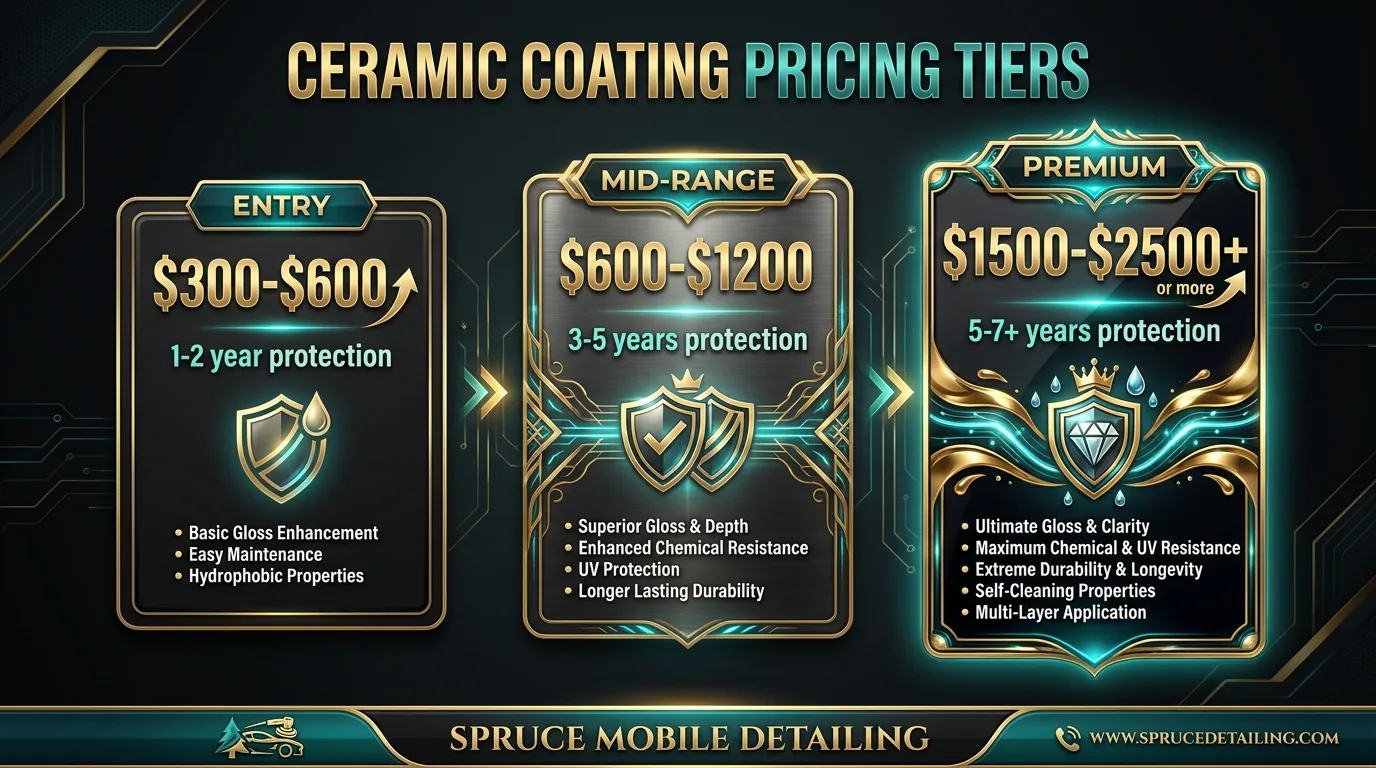
Professional ceramic coating pricing in Douglas County varies depending on the coating system, vehicle size, and condition. Here's a general breakdown of the tiers we offer:
- Entry-level (about 1-year coating): A more accessible investment, good for customers who want hydrophobic properties and UV protection without a long-term commitment.
- Mid-range (about 2 to 5-year coating): Our most popular tier. System X and Glidecoat coatings with multi-year durability at a reasonable investment for the protection you receive.
- Premium (about 5 to 9-year coating): Our top-tier option with multi-layer application and the longest-lasting protection we offer. Best for luxury or newer vehicles.
All tiers include full surface preparation (decontamination, clay bar, and polishing). Real-world durability for every tier depends on how the vehicle is washed and stored. Final pricing depends on vehicle size and condition and is confirmed after we see the vehicle.
For an accurate quote tailored to your vehicle, request a free quote or call us at (720) 971-2020.
Free Quote
We come to your home or office in Castle Rock and throughout Douglas County.
How Long Does Ceramic Coating Take?
A professional ceramic coating service at Spruce Mobile Detailing takes at least one full day for optimal results. Detailers who offer to do the job in hours often skip steps that can affect the overall result of the service. Here is a breakdown of how long our ceramic coating process takes:
- Full exterior wash and decontamination: Our team takes one to four hours to wash your car completely and decontaminate it with a clay bar.
- Paint correction: We take two to ten hours (sometimes a whole day) to polish out swirl marks and light scratches as far as the paint allows; how much can be corrected depends on our assessment of your paint.
- Ceramic coating application: Careful application of professional ceramic coating itself takes one to three hours.
- Curing period: Ceramic coating takes up to 24 hours to cure at the surface level. We'll tell you how long to keep the car dry and, where possible, garaged or covered during this period.
Skipping or rushing steps before coating application compromises the results, which is why we don't rush the preparation. Always keep this timeline in mind when investing in a ceramic coating service so that your car can benefit from a protective layer that lasts for years instead of months.
Ceramic Coating vs. Wax vs. Sealant
The comparison comes down to durability, protection level, and long-term value:
- Car wax (carnauba or synthetic): Lasts 2 to 8 weeks. Provides a warm glow and light protection. You'll reapply many times per year for continuous protection, and the cumulative cost adds up quickly.
- Paint sealant: Lasts 3 to 6 months. Synthetic polymer that's more durable than wax. Reapply 2 to 4 times per year. Better protection than wax, but still a temporary solution.
- Ceramic coating: Typically lasts 2 to 9 years with a single professional application, depending on the product, care, and storage. Bonds to the paint for multi-year durability, though it still needs maintenance washing. One application replaces years of repeated waxing and sealing.
When you factor in the cost of regular waxing over several years versus a single ceramic coating application, ceramic coating typically represents significantly better value over the long term, all while providing superior UV protection, chemical resistance, and hydrophobic properties. For Colorado drivers dealing with intense UV at altitude and harsh winters, ceramic coating is the clear value play.
DIY vs. Professional Ceramic Coating
Consumer ceramic coating products (like the sprays and kits sold at auto parts stores) cost $20 to $100 but differ significantly from professional applications:
- Concentration: Professional products are generally more concentrated than consumer sprays. Higher concentration usually means better durability and a harder coating.
- Durability: Consumer products: weeks to months. Professional coatings: typically 2 to 9 years, depending on the product and care.
- Surface preparation: Professionals decontaminate, clay bar, and correct paint before coating. DIY applications often go over contaminated or scratched paint, locking in defects.
- Application skill: Professional coatings require suitable conditions (clean, dry, shaded panels at the right temperature), precise application techniques, and proper curing. Mistakes can cause high spots, streaking, or rainbow effects that require compound removal.
For everyday cars where you just want some extra protection, a quality consumer sealant is fine (test any new product on a small, hidden area first). For vehicles you care about protecting long-term, or for paint you've invested in correcting, professional coating is worth the investment.
Who Should (and Shouldn't) Get Ceramic Coating
You may be wondering when ceramic coating makes sense for car owners in Castle Rock, Douglas County, and the Denver metro. Let's look at it in detail:
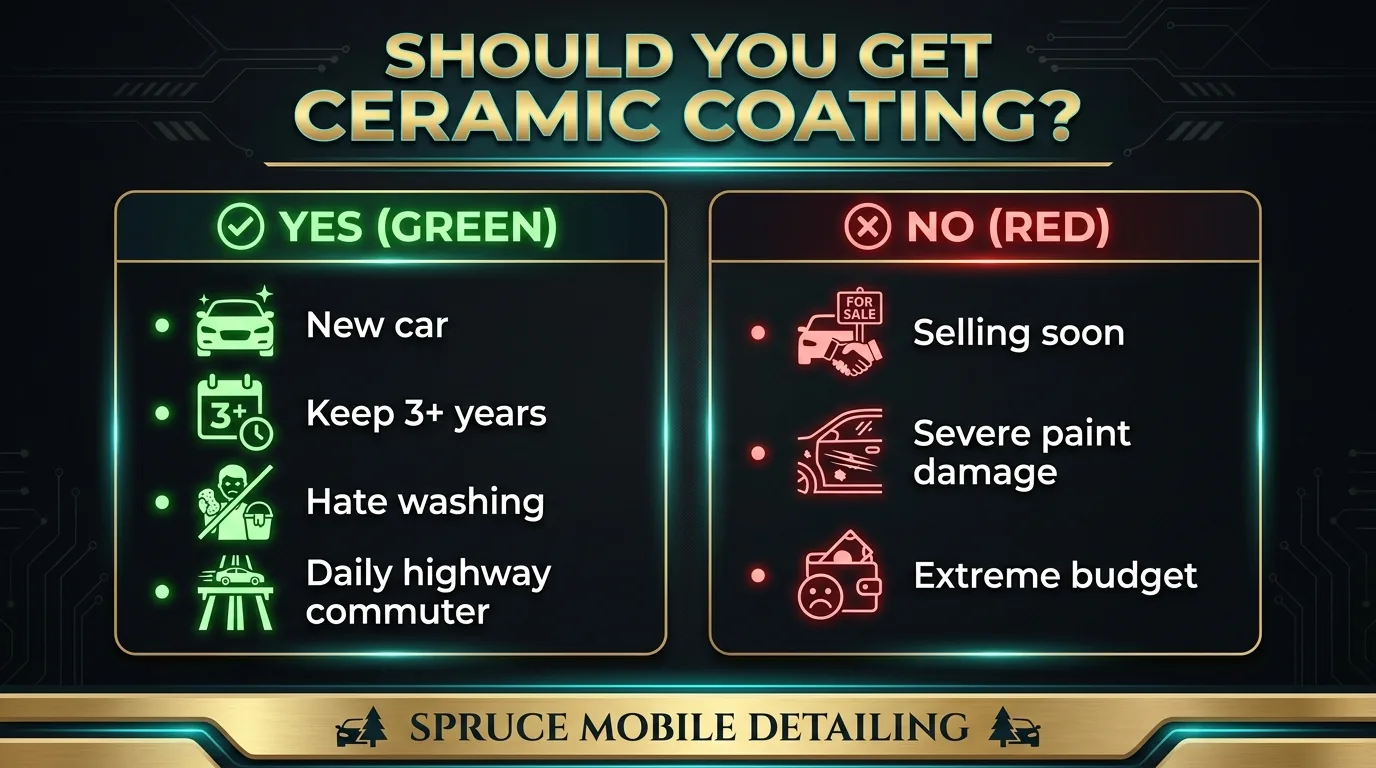
Ceramic coating makes sense if you:
- Plan to keep your vehicle for 3+ years
- Park outside regularly (especially at Colorado altitude)
- Want to reduce wash frequency and effort
- Have invested in polishing and want to protect the results
- Drive a vehicle with dark paint (shows swirl marks and water spots more)
- Want to maintain resale value
It might not be worth it if you:
- Plan to sell or trade in the vehicle within a year
- Have severely damaged paint that needs repainting (not just correction)
- Expect the coating to be maintenance-free (it's low-maintenance, not no-maintenance)
- Are on a tight budget (a quality paint sealant is a solid alternative)
For most vehicle owners in Castle Rock, Highlands Ranch, Centennial, Littleton, Lone Tree, and Castle Pines who plan to keep their vehicles, ceramic coating is a smart investment that pays for itself in reduced maintenance costs and preserved paint condition. Even vehicle owners in the rural stretches of Elizabeth, Larkspur, and Franktown benefit; gravel roads and outdoor parking make ceramic protection especially worthwhile.
The Bottom Line
Is ceramic coating worth it? For most car owners in Colorado, especially those who park outside, care about their paint, and want to reduce maintenance time, yes. The combination of UV protection at altitude, hydrophobic properties for easier cleaning, and long-term cost savings over repeated waxing makes it one of the smartest investments in vehicle care.
The key is choosing an experienced installer who uses professional-grade products and includes proper paint preparation. A suspiciously cheap "ceramic coating special" that skips surface preparation and uses entry-level products won't deliver the results you expect. At Spruce Mobile Detailing, we use professional-grade System X and Glidecoat products, and every coating job includes thorough surface preparation.
Ready to protect your paint? Get a free quote or call us at (720) 971-2020 to discuss the best coating option for your vehicle.
FREQUENTLY ASKED QUESTIONS
How long will ceramic coating last?
Professional ceramic coatings typically last 2 to 9 years depending on the product tier, application quality, how well you maintain it, and whether the car is garaged. Entry-level coatings (about 1 year) are ideal for short-term protection, while premium multi-layer coatings like System X can last 5 to 9 years with proper maintenance washes.
Can you ceramic coat a used car?
Yes, most ceramic coatings are applied to used vehicles. The key is proper surface preparation before coating, involving an exterior wash, decontamination with a clay bar, and paint correction. We reduce swirl marks, light scratches, and oxidation first (how much can be corrected depends on the paint's condition) so you're locking in an improved finish, not flaws.
Which is better, PPF or ceramic coating?
They serve different purposes. Ceramic coating provides UV protection, hydrophobic properties, and easier maintenance. Paint protection film provides physical impact protection against rock chips and scratches. Many customers combine both: PPF on the front end and ceramic coating everywhere else, for the best of both worlds.
Can you apply ceramic coating in winter in Colorado?
Yes, ceramic coating can be applied year-round when conditions allow. Because we are a mobile service, winter coating appointments need extra preparation: a garage or sheltered space and a suitable temperature for application and curing. If the weather doesn't allow it on the day, the appointment may need to be rescheduled.