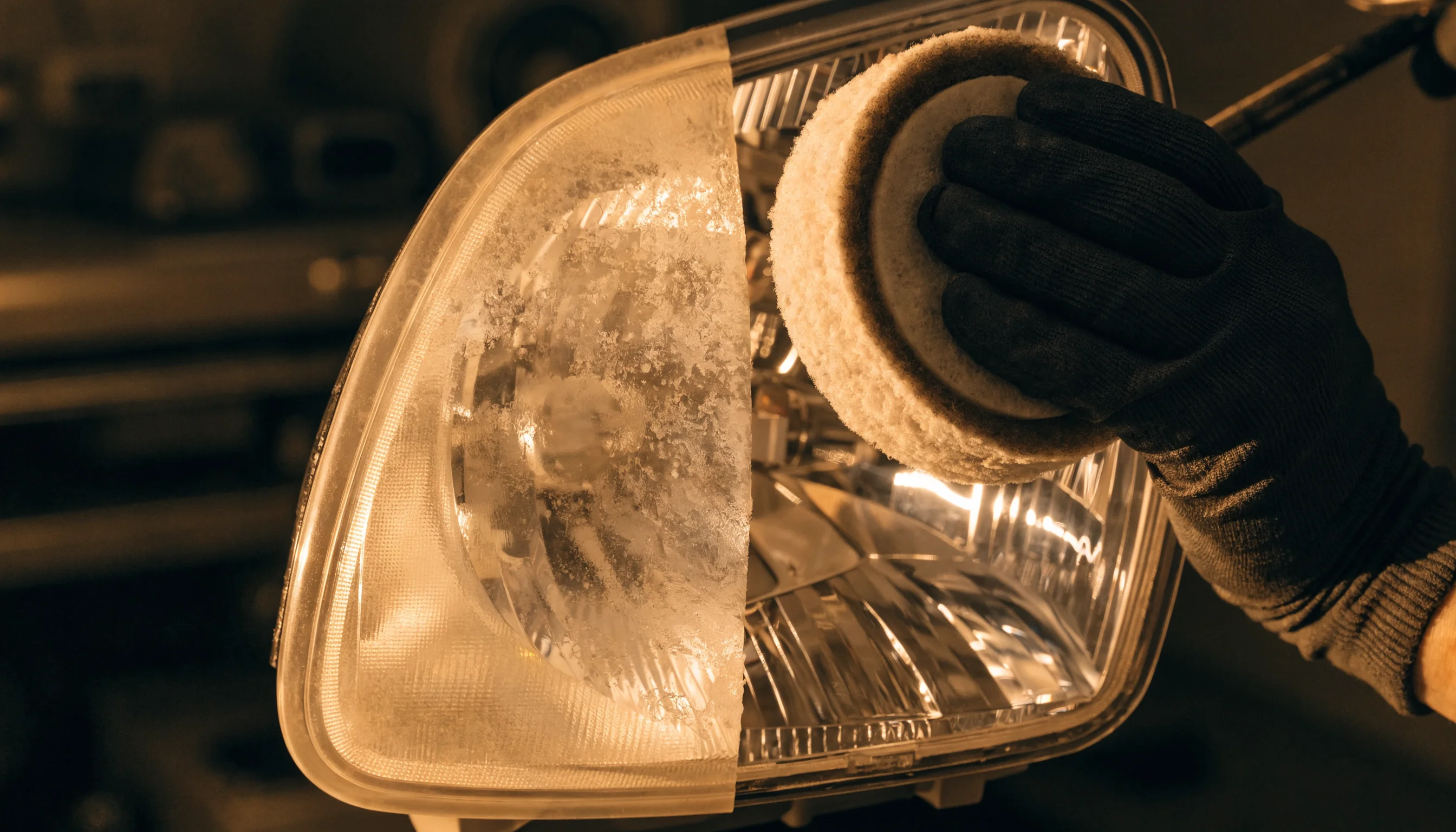
Why Headlights Get Foggy
Modern headlight lenses are made from polycarbonate plastic, not glass. Polycarbonate is lighter and more impact-resistant, but it has a weakness: UV radiation breaks it down over time.
Every headlight lens comes from the factory with a protective UV-resistant clear coat. That coating is the only thing standing between your headlight and the sun. Here in Colorado, at over 6,000 feet of elevation, UV radiation is 25-30% more intense than at sea level. That means the clear coat on your headlights degrades faster here than almost anywhere else in the country.
Once that clear coat fails, the polycarbonate underneath starts to oxidize. It turns yellow, then hazy, then opaque. You've seen it: that milky, cloudy look that makes even a newer car look ten years older. Road grime, chemical exposure from road treatments, and micro-scratches from sand and debris speed up the process.
In Douglas County, we see headlight degradation accelerate between years 3-5 on most vehicles. Cars parked outside in Castle Rock or Parker without garage access tend to develop foggy headlights even sooner.
Safety Implications (It's Not Just Looks)
This is the part most people don't think about until they're driving home on I-25 at night and realize they can barely see the road.
Foggy headlights can reduce light output by up to 80%. That's not a made-up number; it's the reality of how oxidized polycarbonate scatters and blocks light instead of transmitting it cleanly. Your headlight bulbs could be brand new, but if the lens is hazed over, most of that light never reaches the road.
This matters in a few practical ways:
- Reduced nighttime visibility: You see less of the road ahead, which means less reaction time for deer, debris, or stopped vehicles.
- Reduced visibility to others: Oncoming drivers and pedestrians have a harder time seeing you.
- Failed vehicle inspections: While Colorado doesn't have a standard safety inspection, fogged headlights can draw attention during traffic stops and are a common issue flagged in used car pre-purchase inspections.
- Lower resale value: Cloudy headlights are one of the first things buyers notice. It signals neglect, even if the rest of the car is well-maintained.
If you're driving on dark county roads between Castle Rock and Elizabeth or Franktown at night, you want every lumen your headlights can produce.
Restoration vs Replacement
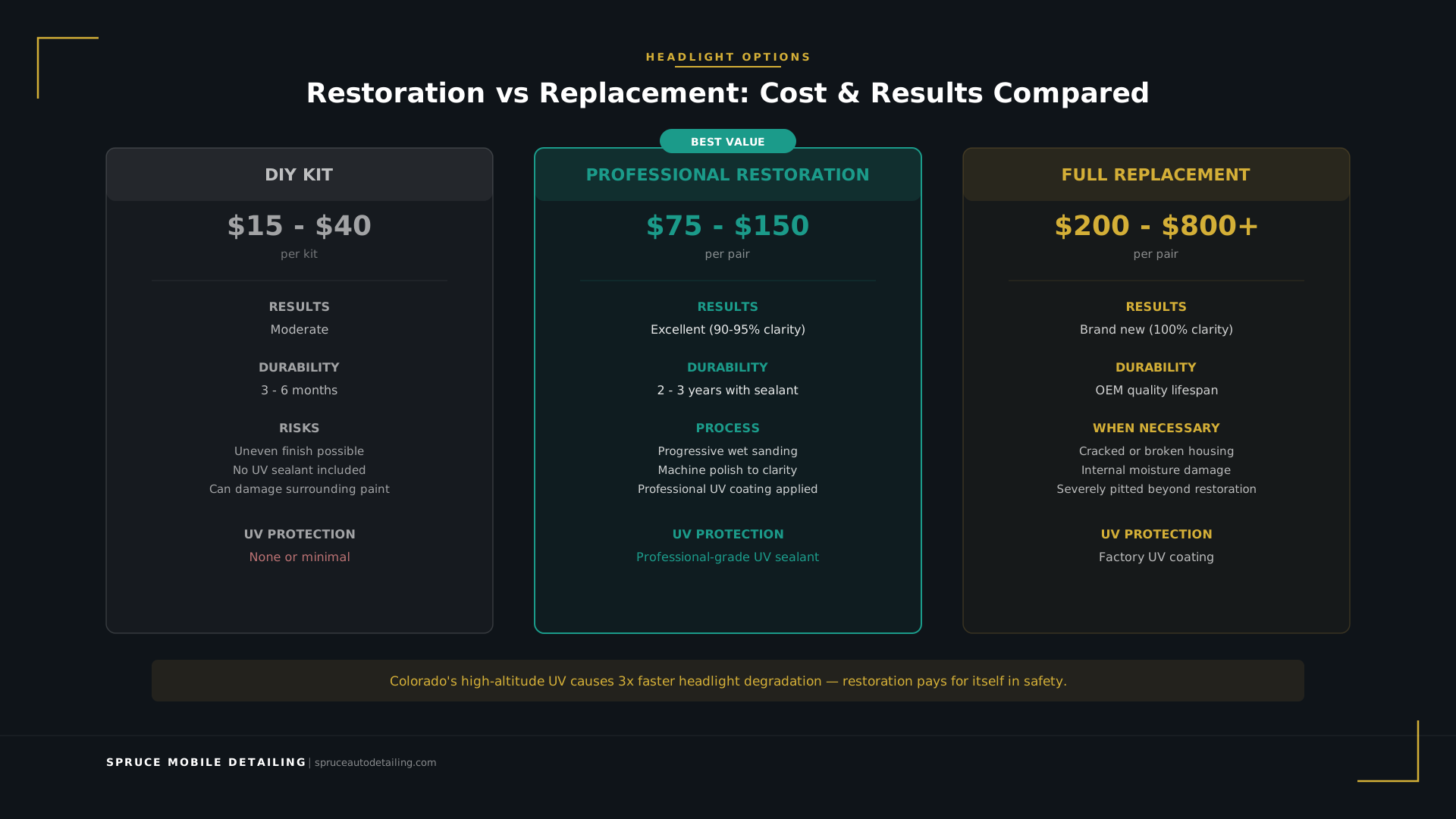
When headlights go foggy, most people assume they need to buy new headlight assemblies. That's certainly an option, but it's an expensive one. OEM headlight assemblies typically run $200-$800 per side depending on the vehicle. For trucks and SUVs with LED or adaptive headlights, you could be looking at $1,000+ per side.
Professional headlight restoration costs a fraction of that and delivers results that last 2-3 years with proper care. The restored lens transmits light just as effectively as a new one.
When does replacement make more sense? If the lens is cracked, has internal moisture (condensation inside the housing), or is so severely degraded that the plastic has become brittle, replacement is the better path. But for the vast majority of foggy headlights we see on vehicles in Douglas County, restoration is the smart move.
We include headlight restoration as an add-on to our detailing services and as part of our restoration packages. It's one of those services where the before-and-after speaks for itself.
Free Quote
Foggy Headlights? We Can Fix That.
We come to your home or office in Castle Rock and throughout Douglas County.
The Restoration Process
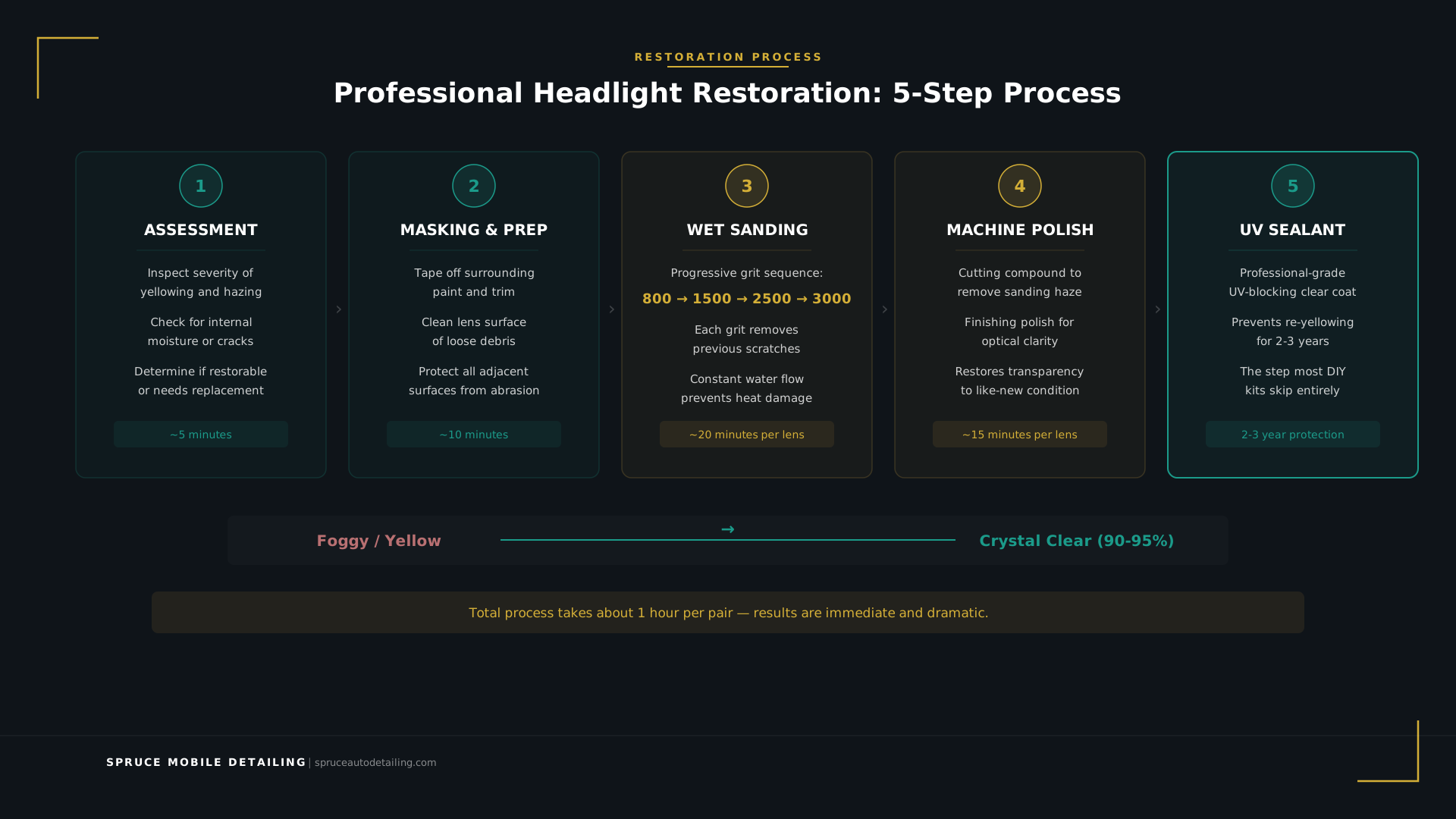
Professional headlight restoration follows a similar philosophy to paint correction: remove the damaged layer, refine the surface, and protect it going forward.
Here's what the process looks like:
- Masking: We tape off the surrounding paint, fender, and bumper to protect them from sanding and polishing compounds.
- Wet sanding: Starting with a coarser grit (usually 800-1000) and progressing through finer grits (1500, 2000, 3000), we remove the oxidized clear coat and a thin layer of damaged polycarbonate. This is done wet to control dust and heat.
- Compounding and polishing: After sanding, the lens looks frosted. We use a machine polisher with plastic-specific compounds to bring back full clarity. This is the step where the lens goes from hazy white to crystal clear.
- UV sealant application: This is the critical step that separates a professional restoration from a $15 DIY kit. We apply a professional-grade UV-resistant sealant that re-establishes that factory protection layer. Without this step, the headlight will re-oxidize within weeks.
The entire process takes about 30-45 minutes per headlight. We do it on-site as part of our mobile service, so there's no need to drop your car off anywhere.
How to Make It Last
Once your headlights are restored, a few simple habits will keep them clear much longer:
- Park in the shade when possible: UV is the primary enemy. A garage is ideal, but even parking under a tree or facing your car away from the afternoon sun helps.
- Apply UV protectant regularly: A quick spray of an automotive UV protectant every few months adds an extra layer of defense. We can recommend specific products that work well.
- Wash headlights during regular washes: Road film and chemical residue accelerate degradation. A quick wipe-down during your regular car wash keeps that buildup in check.
- Consider ceramic coating: If you're getting a ceramic coating on your vehicle, we can coat the headlights too. This provides UV protection and hydrophobic properties that keep the lenses cleaner for longer.
With proper care, a professional headlight restoration in Castle Rock's climate should last 2-3 years before needing a refresh. That's a lot of safe nighttime miles for a minimal investment.
FREQUENTLY ASKED QUESTIONS
How much does headlight restoration cost?
Professional headlight restoration typically runs $75-$150 for a pair, depending on severity. Compare that to $400-$1,600+ for OEM replacement assemblies. We offer headlight restoration as a standalone service or as an add-on to any detailing package.
How long does headlight restoration last?
With a proper UV sealant application, you can expect 2-3 years of clarity in Colorado's climate. Vehicles that are garaged or have ceramic coating on the headlights can go even longer. Without a UV sealant, the oxidation returns within weeks.
Can I restore headlights myself with a DIY kit?
DIY kits work to a degree, but most lack the professional-grade UV sealant that makes the results last. The sanding and polishing is the easier part. The protection step is where most kits fall short, and it's the most important part of the process.