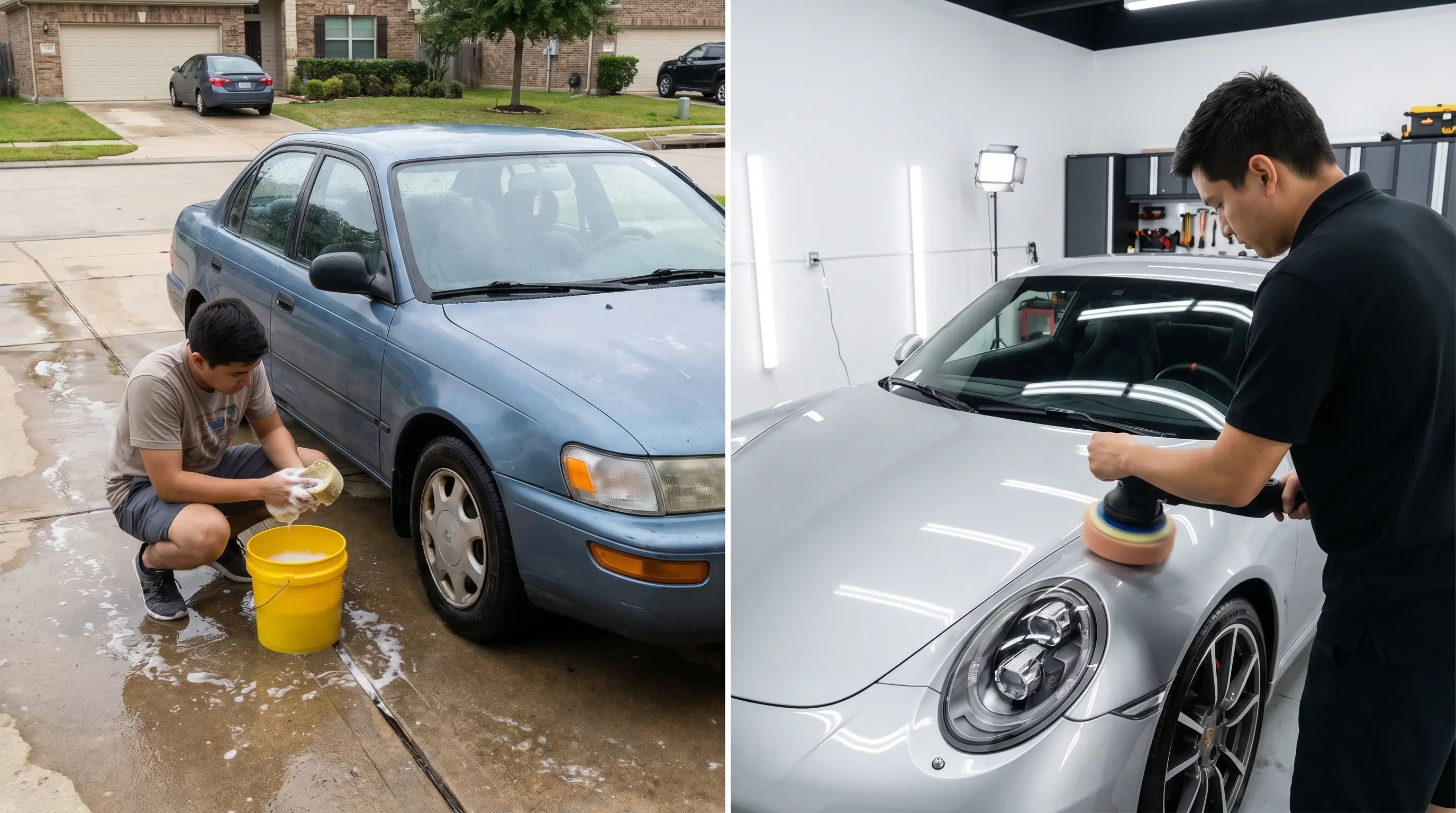
DIY Pros and Cons (Be Honest)
DIY detailing has a lot going for it, and we are not going to pretend otherwise. There is a reason millions of people detail their own cars, and it is not just about saving money.
The pros are real:
- You control the process. Nobody cares about your car as much as you do. When you detail it yourself, you can spend extra time on the spots that matter to you and take as long as you need.
- It is satisfying. There is genuine enjoyment in spending a Saturday morning washing, claying, and polishing your car, then stepping back and admiring the result. The detailing community exists because people love doing this.
- You learn about your car. Hands-on detailing teaches you what your paint looks like, where the trouble spots are, and how to maintain it between deeper cleans.
- Lower per-session cost. Once you own the basic equipment, each wash and detail costs just a few dollars in product.
The cons are also real:
- Time investment is significant. A proper DIY full detail takes 4 to 8 hours depending on your experience and equipment. That is a full Saturday. Every. Three. Months.
- Startup costs add up fast. A quality wash setup (two buckets, grit guards, wash mitt, drying towels, soap) runs $100 to $150. Add a clay bar kit ($30), polish and polisher ($200 to $400), sealant ($25), interior cleaners ($50), and a vacuum ($100 to $300). You are easily at $500 to $900 before your first detail.
- Learning curve is steep for paint correction. Machine polishing requires skill. Too much pressure, wrong pad, wrong product, or wrong technique can burn through clear coat. This is not a casual learning-on-the-job task.
- Results plateau without professional equipment. Consumer-grade extractors, polishers, and vacuums simply cannot match professional equipment. Your results will be good but not professional-grade.
- Water and space requirements. You need a driveway, a hose, shade (polishing in direct sun is a recipe for disaster), and space to lay out your equipment. Not everyone has that, especially in Colorado winters.
Professional Pros and Cons (Be Honest)
Professional detailing is not magic, and there are legitimate reasons why some people prefer DIY. Here is the honest truth about what a pro offers and where the downsides are.
The pros:
- Better equipment. Professional-grade polishers, extractors, steam cleaners, and lighting make a measurable difference in results. A commercial hot water extractor, for example, generates far more heat and suction than any consumer carpet cleaner, which matters when you are trying to pull embedded mag chloride out of Colorado carpets.
- Trained technique. A professional detailer has done this hundreds or thousands of times. They know how different paints react, how to adjust pressure and speed during polishing, and how to handle delicate surfaces without damage.
- Time savings. A professional does in 3 to 5 hours what might take you 6 to 8 hours with consumer equipment. And your time is free because you are doing whatever you want while they work.
- Access to professional-only products. Many top-tier ceramic coatings, correction compounds, and protection products are only available to certified installers. The consumer versions are different formulations.
- Accountability. A professional with insurance and a reputation has skin in the game. If something goes wrong, they make it right.
The cons:
- Higher per-session cost. A full professional detail runs $200 to $500 depending on the vehicle and service level. That is real money.
- Scheduling required. You need to book ahead, and popular times fill up. You cannot just decide on Saturday morning to get a detail that afternoon.
- Trusting someone with your vehicle. You are handing over your car to someone else. That requires trust in their competence and care, which can be hard to establish with a new detailer.
- Quality varies wildly. Not all professionals are equal. The detailing industry has no licensing, so quality ranges from exceptional to worse-than-DIY. You need to vet your detailer.
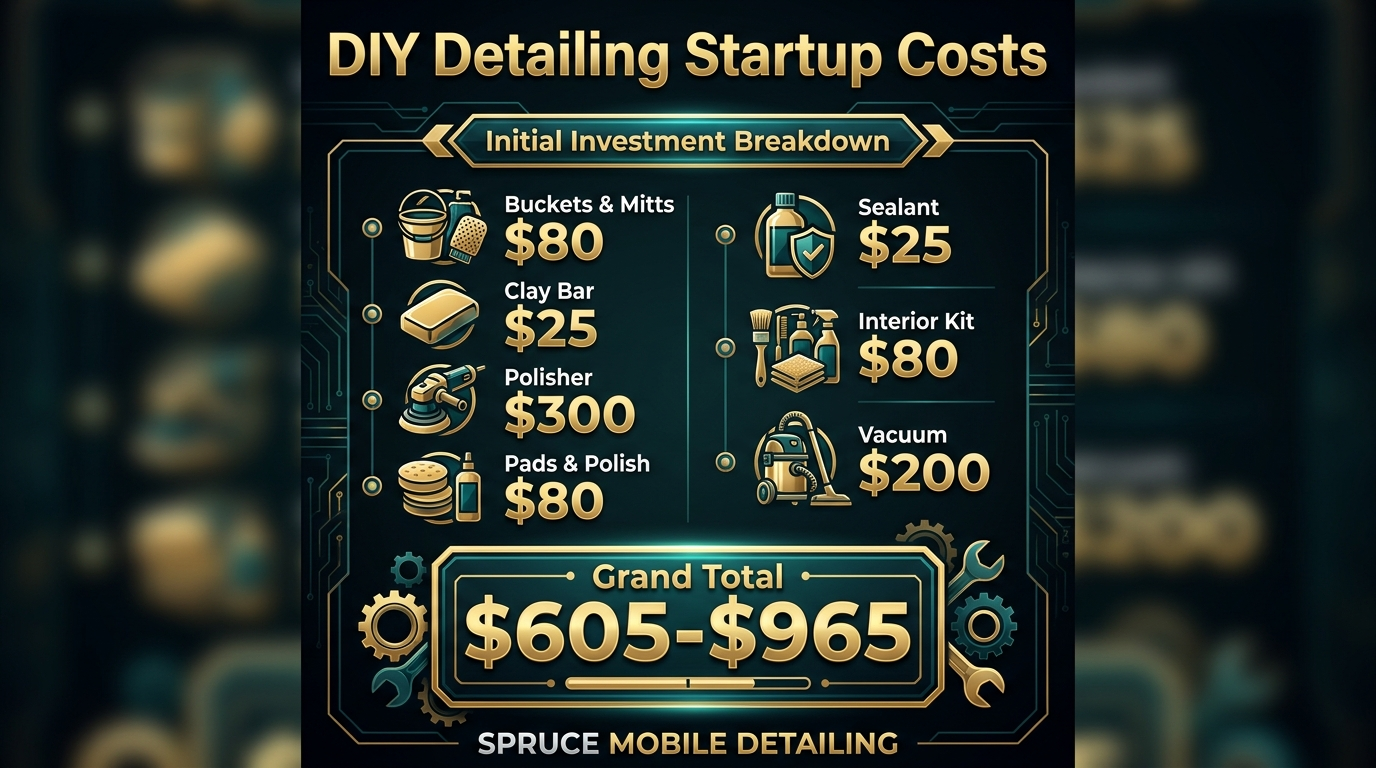
Real Cost Comparison (Products + Time vs Pro Fee)
Let us do the actual math. People often compare the cost of a professional detail ($300) to the cost of a bottle of soap ($10) and conclude DIY is dramatically cheaper. That comparison ignores a lot of costs.
DIY startup costs (one-time):
- Two buckets with grit guards: $40
- Wash mitt and drying towels: $40
- pH-neutral car soap: $15
- Clay bar kit: $25
- Dual-action polisher: $200 to $400
- Polishing pads (3 to 4 types): $40
- Polishing compound and finishing polish: $40
- Paint sealant: $25
- Interior cleaner and leather conditioner: $40
- Interior brushes and microfiber towels: $40
- Vacuum (decent shop vac or detailing vacuum): $100 to $300
Total startup: $605 to $965
DIY ongoing costs per detail: Roughly $20 to $30 in consumable products (soap, towels, compound) plus 5 to 8 hours of your time.
Professional cost per detail: $250 to $400 for a full detail, 0 hours of your time.
The time factor is the real comparison. If you value your free time at $30 per hour (a conservative number for most Douglas County residents), a 6-hour DIY detail has a time cost of $180 plus $25 in products, totaling $205. A professional detail at $300 costs $95 more but gives you 6 hours of your Saturday back.
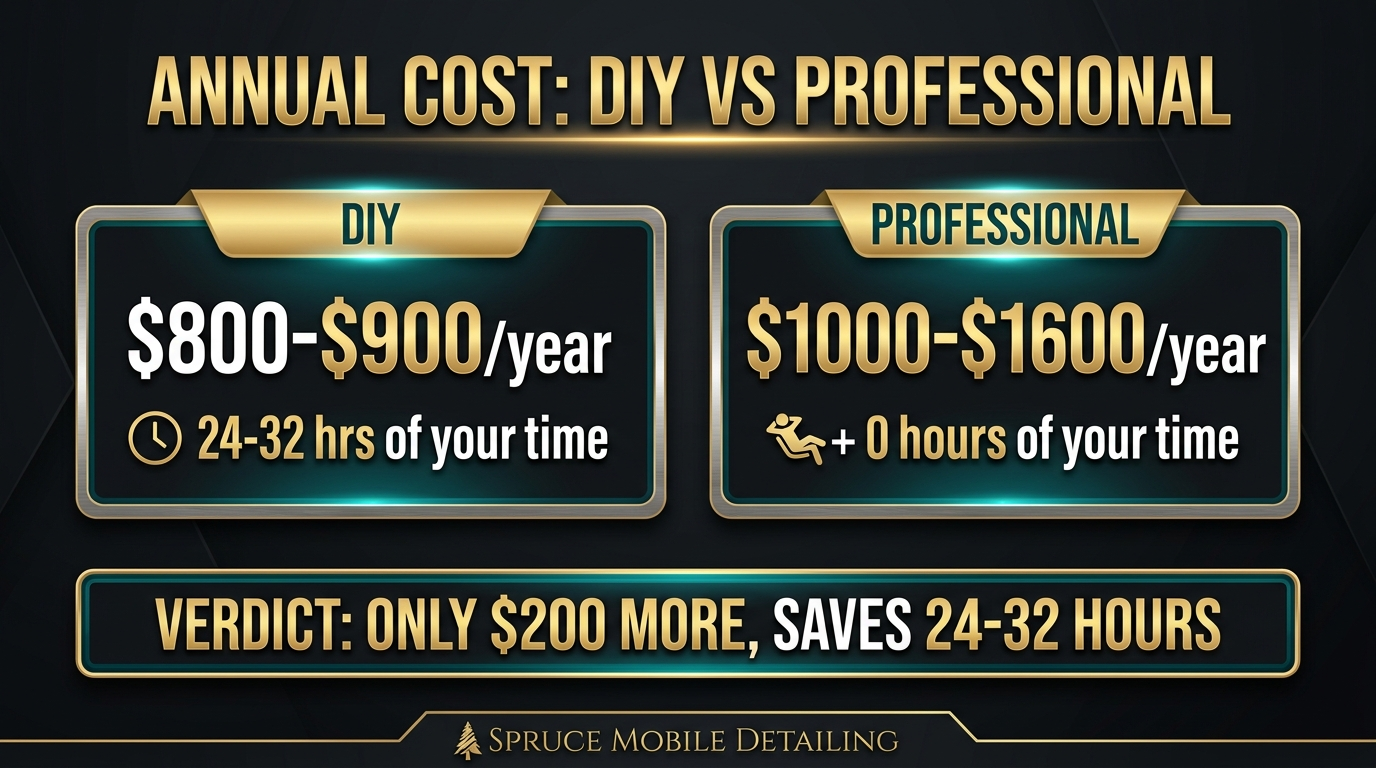
Over a year with 4 seasonal details: DIY costs roughly $800 to $900 including amortized equipment plus time. Professional costs $1,000 to $1,600 with zero time investment.
The real cost difference is much smaller than it appears at first glance.
Free Quote
Ready for Professional-Grade Results?
We come to your home or office in Castle Rock and throughout Douglas County.
What DIY Can't Do (Paint Correction, Extraction)
There are some services where the gap between DIY and professional is not just about quality, it is about capability. These are the areas where we strongly recommend going pro.
Multi-stage paint correction. Removing deep swirl marks, scratches, and oxidation requires a specific combination of cutting compounds, polishing compounds, pad types, machine speeds, and arm angles that take years to master. One wrong move and you burn through the clear coat, creating damage that is far worse than the swirl marks you were trying to fix. Professional paint correction is also a prerequisite for ceramic coating, because coating over damaged paint locks in the damage.
Professional ceramic coating application. True ceramic coating (not the spray bottles at AutoZone) requires meticulous surface preparation, precise application in controlled conditions, and proper curing management. A mistake during application, like a high spot or missed area, is visible and requires compound removal to fix.
Deep interior extraction. Consumer carpet cleaners push about 50 to 60 PSI of water pressure and have limited suction. Professional extractors push 100 to 500 PSI with significantly more vacuum power. In Colorado, where mag chloride crystallizes deep in carpet fibers, that difference matters enormously. We regularly extract brown, salt-laden water from carpets that the owner thought were clean.
Paint protection film (PPF) installation. PPF requires precision cutting, heat-gun molding, and experience working with adhesive film on compound curves. This is not a DIY-friendly service.
Wet sanding and headlight restoration. Wet sanding requires knowing exactly how much material you can safely remove. Go too deep and you are into the base coat. Professional restoration work requires that level of skill.
The Hybrid Approach (DIY Maintenance + Occasional Pro)
Here is what we actually recommend for most people, and it might surprise you coming from a professional detailing business. The smartest approach is a hybrid.
DIY between professional details:
- Wash your car every 2 to 4 weeks with a proper two-bucket method and pH-neutral soap. This is easy, fast (30 to 45 minutes), and keeps contaminants from bonding.
- Quick-vacuum the interior every week or two, especially in winter when salt is getting tracked in.
- Wipe down leather and dashboard surfaces monthly with appropriate products.
- Apply a spray sealant or ceramic booster after washing to maintain hydrophobic protection.
Go professional for the big stuff:
- Get a professional full detail 2 to 4 times per year for deep decontamination, polishing, extraction, and leather conditioning.
- Leave paint correction, ceramic coating, and PPF to the pros.
- Consider a professional interior extraction at least in spring to remove winter's accumulated salt and grime.
This approach gives you the best of both worlds. You stay connected to your car's condition through regular maintenance, and the professional details handle the work that requires specialized equipment and expertise.
The cost? You spend maybe $200 per year on DIY products and time, plus $600 to $1,200 on 2 to 4 professional details. Your car stays in better condition than either approach alone, because you are catching issues between pro visits and the pros are handling what you cannot.
If you are in Castle Rock and want to set up a schedule that balances DIY maintenance with professional detailing, give us a call at (720) 971-2020. We will help you figure out what makes sense for your specific situation.
FREQUENTLY ASKED QUESTIONS
Is it worth paying for professional detailing?
For deep cleaning, paint correction, ceramic coating, and services requiring professional equipment, yes. The results and efficiency of professional work justify the cost. For basic maintenance washing and interior wipe-downs, DIY is perfectly fine and we encourage it between professional details.
What detailing products should I buy for DIY maintenance?
Start with the basics: pH-neutral car soap, a quality wash mitt, two buckets with grit guards, microfiber drying towels, a spray sealant or ceramic booster, interior cleaner, leather conditioner, and glass cleaner. Skip the machine polisher until you have experience. Total starter cost is about $150 to $200.
Can I do my own paint correction?
We recommend against it unless you have been trained or extensively practiced. Machine polishing with the wrong technique, pad, or compound can burn through clear coat, creating permanent damage. A one-step light polish with a dual-action polisher is lower risk, but multi-stage correction should be left to professionals.
How much money does DIY detailing actually save?
Less than you think when you factor in equipment costs and time. After startup costs of $600 to $900 and 5 to 8 hours per detail session, the per-detail savings over professional work is roughly $50 to $100. The real savings come from DIY maintenance washes between professional details, which is the hybrid approach we recommend.