
The Salt Problem (Mag Chloride Explained)
If you have ever noticed a white, crusty film on your floor mats after a Colorado winter, you have met magnesium chloride. CDOT applies millions of gallons of this stuff to our roads every winter season, and it is far more damaging to your car's interior than regular rock salt.
Here is the problem. Mag chloride does not just sit on the surface. It is hygroscopic, meaning it actively pulls moisture from the air. That white residue on your carpet is not just dried salt. It is a chemical compound that keeps reactivating every time humidity changes, which in Colorado means constantly.
What mag chloride does to your interior:
- Carpet and floor mats: It crystallizes in the carpet fibers, creating a rough, stiff texture that regular vacuuming cannot remove. Over time, it weakens the carpet backing and causes premature wear.
- Rubber floor liners: Even all-weather mats are not immune. Mag chloride can cause rubber to dry out, crack, and lose flexibility over time.
- Metal components: Seat rail mechanisms, seat belt anchors, and door sill plates can corrode from prolonged mag chloride exposure tracked in on your shoes.
The worst part is that most people do not address it until spring. By then, the salt has been sitting in your carpet for four to five months, bonding deeper with every temperature cycle. A standard vacuum will not touch it. You need hot water extraction to dissolve and pull out the crystallized mag chloride from deep in the carpet fibers.
Drivers in Castle Rock, Parker, and Highlands Ranch deal with this every single winter because I-25 and the local roads get treated heavily.
Red Dirt: It's Everywhere and It Stains
Colorado's red dirt is not just dirt. It is iron-oxide-rich clay soil, and it stains everything it touches. If you have ever tried to get that rusty orange color out of a white t-shirt, you know exactly what we are talking about.
The problem with red dirt in your car interior is that it does not just sit on top of carpet fibers. The iron oxide particles are incredibly fine and they embed themselves into fabric at a microscopic level. Once they bond, regular vacuuming and spot cleaning barely touch them.
Where does it come from? Everywhere. Construction sites along I-25, the unpaved shoulders of county roads, gravel parking lots, hiking trail trailheads, and basically any time you step off pavement in Douglas County. You track it in on your shoes without even noticing.
Light-colored interiors suffer the most. Tan and grey carpets show red dirt stains almost immediately. Even dark carpets accumulate it over time, and when you do a deep clean, you will be amazed at the amount of red-tinted water that comes out.
The key to dealing with red dirt is not to let it accumulate. Regular vacuuming (once a week if you are on dirt roads frequently) prevents the particles from working deeper into the fibers. When stains do set in, a professional hot water extraction with an iron-dissolving pre-treatment is the most effective way to restore the carpet.
Altitude + Dry Air = Cracked Leather
Colorado's average humidity hovers around 30 to 40%, and in winter it can drop below 20%. For context, the Sahara Desert averages about 25%. Your car's leather interior is essentially sitting in near-desert conditions year-round.
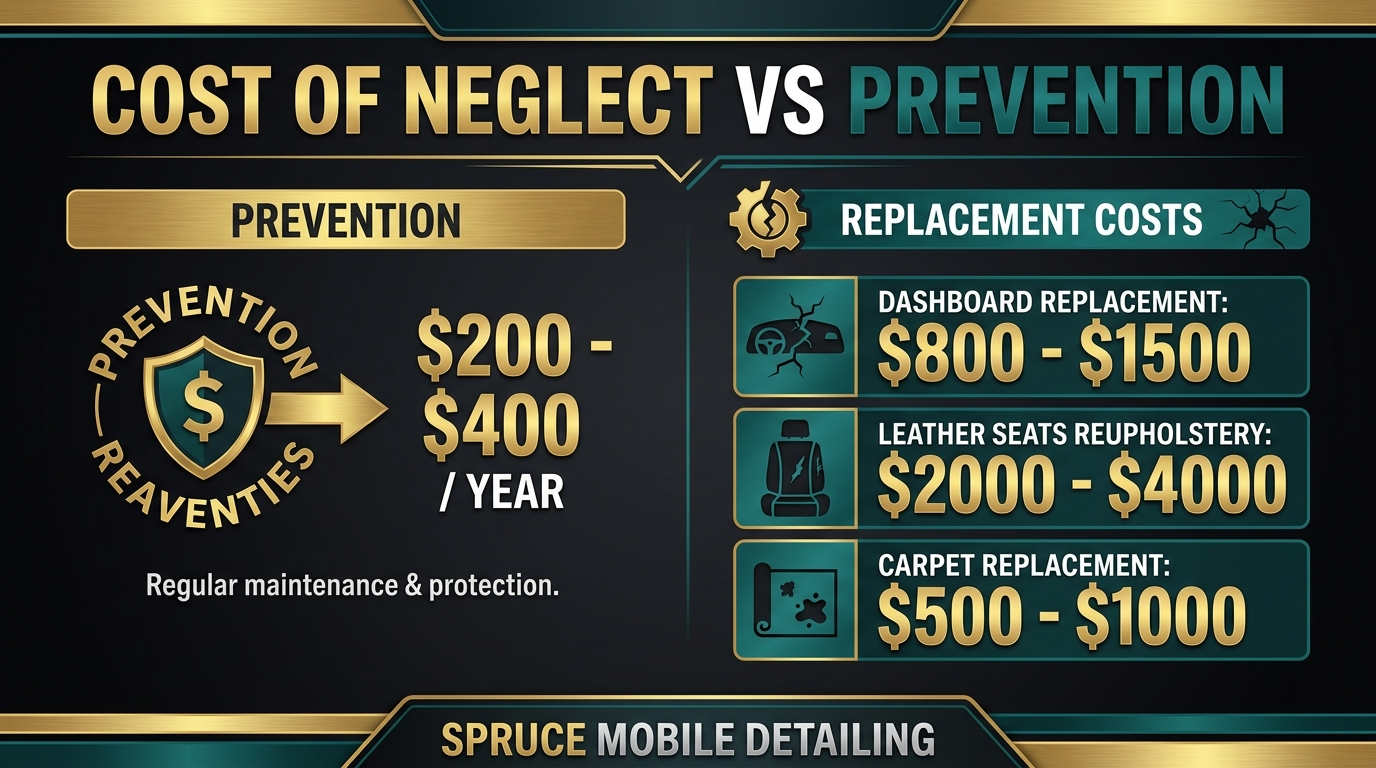
Leather is skin. It needs moisture to stay supple. When leather dries out, the fibers shrink and stiffen. You start seeing hairline cracks in the seat bolsters (the sides of the seat that you slide against getting in and out). Then the cracks spread. Then they split. At that point, you are looking at seat repair or replacement, which easily costs $500 to $2,000 per seat.
Add in our intense UV radiation at 6,000+ feet and the damage accelerates. UV breaks down the dye and finish on leather surfaces. You will notice the driver's seat fading and wearing faster than the passenger side because it gets the most use and sun exposure.
The fix is straightforward but it has to be consistent. Leather needs to be cleaned and conditioned every 3 to 4 months. The cleaner removes body oils, sunscreen, and grime that degrade the finish. The conditioner restores moisture and creates a barrier against UV and dry air. Skip it for a year, and you start seeing irreversible damage.
This applies across all of Douglas County. Whether you are in Castle Rock, Highlands Ranch, or Parker, the altitude and dry air are the same, and your leather is suffering the same consequences.
Free Quote
Interior Looking Rough After Winter?
We come to your home or office in Castle Rock and throughout Douglas County.
How to Protect Your Interior Year-Round
You do not need to accept a trashed interior as the cost of living in Colorado. Here is a seasonal approach that actually works.
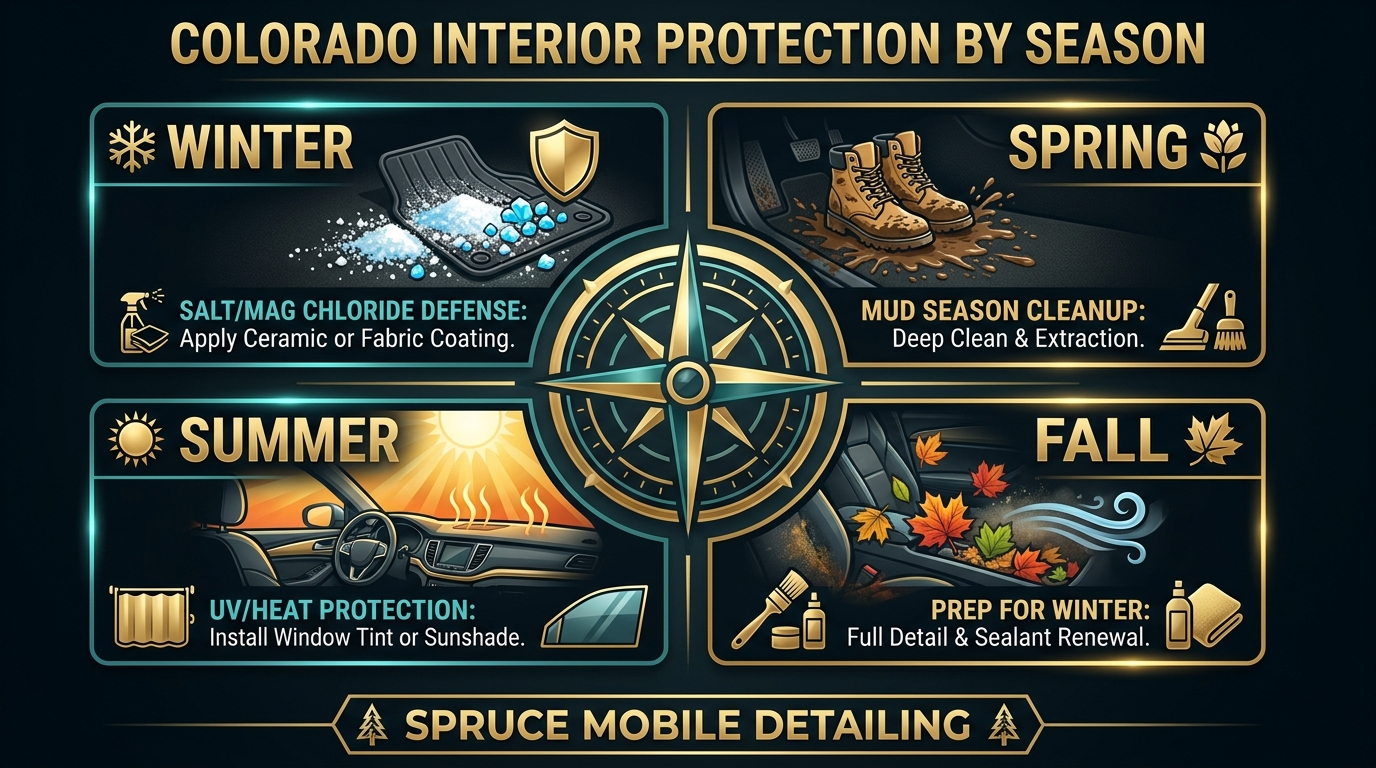
Winter (November to March): This is the hardest season on interiors. Use all-weather rubber floor mats to catch the worst of the mag chloride and snow melt. Shake out and rinse your mats every 2 to 3 weeks. Wipe down leather surfaces monthly with a damp cloth to remove salt film before it can do damage. Vacuum carpets and seats weekly if possible.
Spring (April to May): This is when you undo winter's damage. Get a full interior detail with hot water extraction to pull out all the embedded mag chloride, red dirt, and grime that accumulated over winter. Condition leather thoroughly. This one appointment makes the biggest difference of the year.
Summer (June to August): UV is the primary threat now. Use a windshield sunshade when parked. Apply a UV protectant to the dashboard and door panels every time you detail. Leather conditioning is critical in summer because the combination of heat and dryness accelerates cracking. Park in the shade when you can.
Fall (September to October): This is your prep season. Get a detail before winter hits to start with a clean slate. Apply leather conditioner so your seats go into winter moisturized. Consider having your carpets and fabric seats treated with a fabric protectant that creates a barrier against winter's incoming onslaught.
When to Call a Professional
Some interior problems are DIY-fixable. Light vacuuming, wipe-downs, and basic leather conditioning are things every car owner should do between professional details. But there are situations where professional equipment and expertise make a real difference.
Deep salt stains in carpet: If vacuuming and spot cleaning are not removing the white mag chloride residue, you need professional hot water extraction. Our commercial extractors generate more heat and suction than consumer carpet cleaners, and we use cleaning agents specifically formulated to dissolve mag chloride.
Set-in red dirt stains: Once iron oxide bonds with fabric fibers, you need a pre-treatment that dissolves the iron particles before extraction. This is not something you can buy at the auto parts store. We use professional-grade iron fallout removers that are safe for interior fabrics.
Cracked or faded leather: If your leather is already showing cracks or significant fading, a professional can assess whether conditioning can still help or if you need a leather restoration treatment. Catching it early saves a lot of money.
Stubborn odors: Mildew from wet boots, food spills, and that mystery smell that will not go away often require enzyme treatments or ozone treatment that are beyond what an air freshener can mask.
We see Colorado-specific interior damage every single day. It is what we do. If your interior is showing the signs we talked about, reach out for a free quote or call us at (720) 971-2020. We come to your home in Castle Rock, Parker, Highlands Ranch, and throughout Douglas County.
FREQUENTLY ASKED QUESTIONS
How do I remove mag chloride stains from my car carpet?
Mag chloride requires hot water extraction to fully remove. Regular vacuuming only gets the surface layer. A professional detail with hot water extraction dissolves the crystallized salt deep in the carpet fibers and pulls it out. For light stains, you can try a mix of white vinegar and warm water, but set-in stains need professional equipment.
Why is my leather cracking even though my car is only a few years old?
Colorado's dry air at altitude (often below 30% humidity) pulls moisture out of leather rapidly. Combined with UV radiation that is 25 to 30% more intense than sea level, leather can start cracking within 2 to 3 years if it is not cleaned and conditioned regularly. Conditioning every 3 to 4 months prevents this.
How often should I get my interior detailed in Colorado?
We recommend a full interior detail at least 3 to 4 times per year in Colorado, ideally once each season. The most critical appointment is in spring after winter to remove accumulated mag chloride and road grime. Between professional details, regular vacuuming and leather wipe-downs go a long way.
Do all-weather floor mats really help protect my carpet?
Yes, rubber all-weather floor mats are one of the best investments for Colorado drivers. They catch the bulk of mag chloride, mud, and snow melt before it reaches your carpet. Just make sure to remove and rinse them every few weeks during winter so they do not overflow onto the carpet underneath.